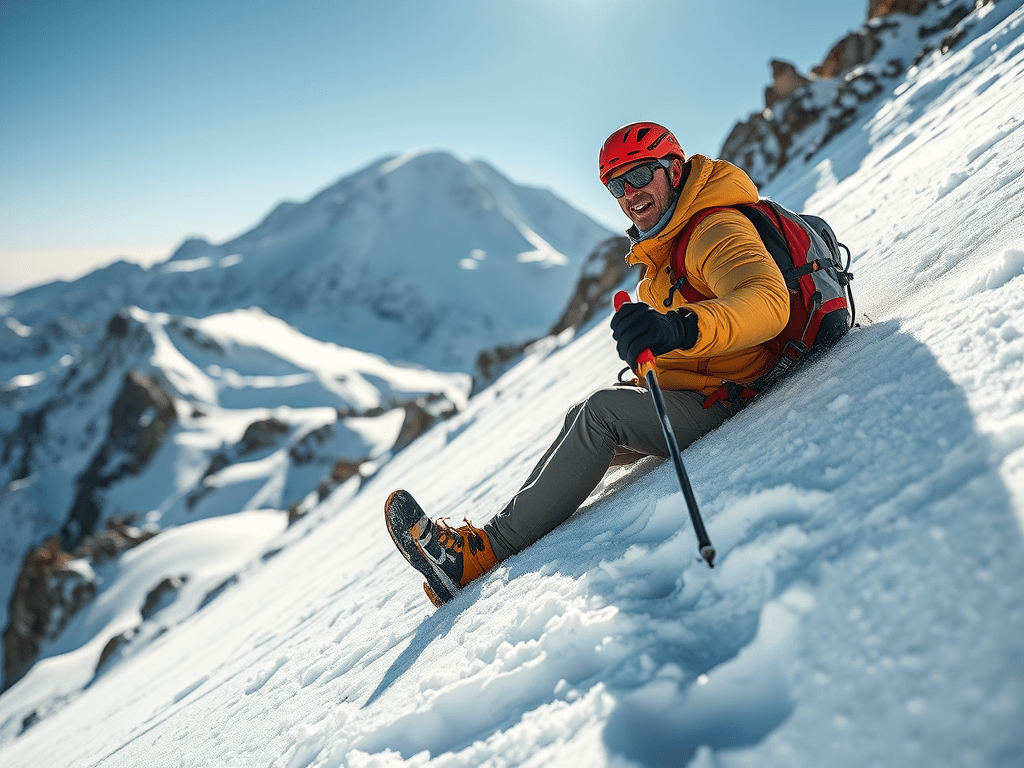
I once slid down Mount Hood on my butt.
Perhaps I should explain.
Several decades ago, I signed up for a college mountaineering class and climbed Mount Hood. On the way down, our instructor taught us to glissade.
Glissading, says Wikipedia, is
…a climbing technique mostly used in mountaineering and alpine climbing where a climber starts a controlled slide down a snow and/or ice slope to speed up their descent…
Most glissading is done in a seated position…with the legs bent to absorb shocks and bumps, and an ice axe held diagonally across the body to be in a position to perform a self-arrest if the glissade starts to get out of control.
When I first sat down in the snow and pushed, I didn’t move. Then I was flying—too fast. I jammed the axe into the slope, bounced over some rocks, and finally stopped, shaking and exhilarated.
Full disclosure: I did not slide ALL THE WAY down Mount Hood — it was maybe a hundred feet. But this is my blog, and I will exaggerate whenever I damn well feel like it.
I’ll also admit to a moment of panic… a short section where it felt like I was about to become mountain pizza.
What brought me back under control? The ice axe, and a mountaineering instructor who’d taught me to steer.
I thought about that ride as a read this passage in Lewis Richmond’s Aging As a Spiritual Practice:
Once, one of my workshop attendees raised his hand and half jokingly said, “I’m fifty-eight and I know where I’m headed – downhill. It’s all downhill from here.”
I thought for a moment and replied, “well, I’m not sure I agree, but even if you’re right, the real question is: are you going to just slide, or are you going to steer?”
.
We’re all heading downhill. As we get older, the parts wear out — and not all of them can be replaced. Add a Parkinson’s diagnosis to the mix, and it’s tempting to lie down on the couch and cry.
Which I’ve done, on occasion. I’m not a pretty crier.
But as 2026 gets underway, there are many opportunities for us to influence the journey.
- Medications and surgery to control the symptoms.
- Exercise programs to slow the progression — sometimes for many years.
- Support groups to put us in a room with others who understand what we’re dealing with.
- Clinical trials testing a wide variety of therapies and potential cures.
In the r/Parkinsons subgroup on Reddit, a poster called OldRounder recently discussed his decision to take up basketball after a several-decades break. He’d been a good player into his 40’s. Now he was near 60, with Parkinson’s.
His first few times on the court didn’t go well, but he stuck with it:
It was shocking how much my skills had degraded. My right hand was weak and uncoordinated. I could barely hit two out of 10 free throws and shot mostly air balls. Dribbling was a joke. That was in February of this year. I’ve been doing basketball workouts 3 + times a week since then.
Gradually, in fits and starts, my skills started improving. Before, shooting a basketball was something that just came second nature to me. Pure muscle memory. Never thought about it. Now I had to train my entire brain and body to move and shoot again. There were times when I would hit two or three shots in a row and then two or three air balls because I didn’t have control with my body anymore. It was like there was a blockage between my brain and my body.
Today was the first time I hit ten free throws in a row. I had to concentrate on every aspect of the shooting motion, but I was able to do it. It doesn’t sound like much of an achievement, but it literally took hundreds of hours to get here. More importantly, it took belief in myself that I could improve and do it.
A Parkinson’s diagnosis tries to convince us the downhill journey will be bumpy and painful, with an ugly crash at the bottom.
Maybe. But it doesn’t have to be passive. We have the opportunity to live well on the way down.
Every day there are tens of thousands of people like OldRounder at boxing gyms, ping pong tables and pickleball courts, dance classes, and support groups who have decided to exercise agency over the disease.
We can lie back and slide to the bottom. Or we can grab an ice axe and steer.
.
Bonus for Those Who Read to the Bottom
The “Munsters” theme as a surf instrumental.
.
There aren’t a lot of Toto covers played on vegetables. Or fruit. Or squash, which I have learned is sometimes classified as a fruit and at other times as a vegetable.
Anyway, enjoy “Africa,” which begins at 1:40.
.
Fifteen years ago, some guy posted a strange-but-compelling ukulele cover of “Like a Rolling Stone.” In 2026 I found it.






 Shakin' Street -- A Parkinson's Blog
Leave a comment