
On May 23, the United States Senate unanimously passed the National Plan to End Parkinson’s Act. Previously, the House of Representatives passed the Act on a vote of 407-9, so this sends the bill to President Biden’s desk to be signed.
The full text of the bill is here.
Among the provisions,
The Secretary of Health & Human Services will establish an Advisory Council on Parkinson’s Research, Care, and Services. According to Dustin Watson, the Government Relations Director for the Michael J Fox Foundation, the council will have about two dozen members. Roughly 14 of them will be from the government, and the other 10 will be nonfederal stakeholders – people with Parkinson’s, caregivers, nonprofits, and others in the Parkinson’s community.
Once established, the Council will meet each quarter, convene an annual meeting of federal and nonfederal stakeholders, and report on how everything is going.
My initial reaction on hearing the news was that while it’s great that Congress is paying attention to Parkinson’s, there did not appear to be any money appropriated to the effort.
I wondered how this was going to move the needle.
In an interview with Larry Gifford of PD Avengers, Dustin Watson set me straight. Watson explains that the National Plan to End Parkinson’s Act was modeled on the National Alzheimer’s Project Act, signed into law in January 2011.
The National Alzheimer’s Project Act has had a profound effect on government funding for Alzheimer’s research.
In 2011, the year the bill was signed, federal funding for Alzheimer’s research was about $448 million.
In 2023, federal funding for Alzheimer’s is $3.8 billion. This huge increase in funding appears, at least in part, to be a direct result of the attention the National Alzheimer’s Project Act gave to the efforts to treat and cure the disease.
By contrast, Watson reports that the current federal investment for Parkinson’s research is $270 million. There is plenty of room to grow, and this act provides a jumpstart to Parkinson’s research efforts.
Before we get too excited, a quick note of caution. $3.8 billion is a very impressive number, but 13 years after the passage of the National Alzheimer’s Project Act, we still don’t have a cure for that disease. It is way too soon to spike the football.
A cure, if and when it comes, may be too late to benefit me and those of my generation. But we are heading in the right direction.
In the meantime, I am trying to do my small part by participating in a research study at Oregon Health & Science University. Last week I spent three hours in a room at OHSU, hooked up to the gizmos you see at the top of this post.
The research team sent me home with some “smart socks,” I am expected to wear over my regular socks during waking hours for seven days.
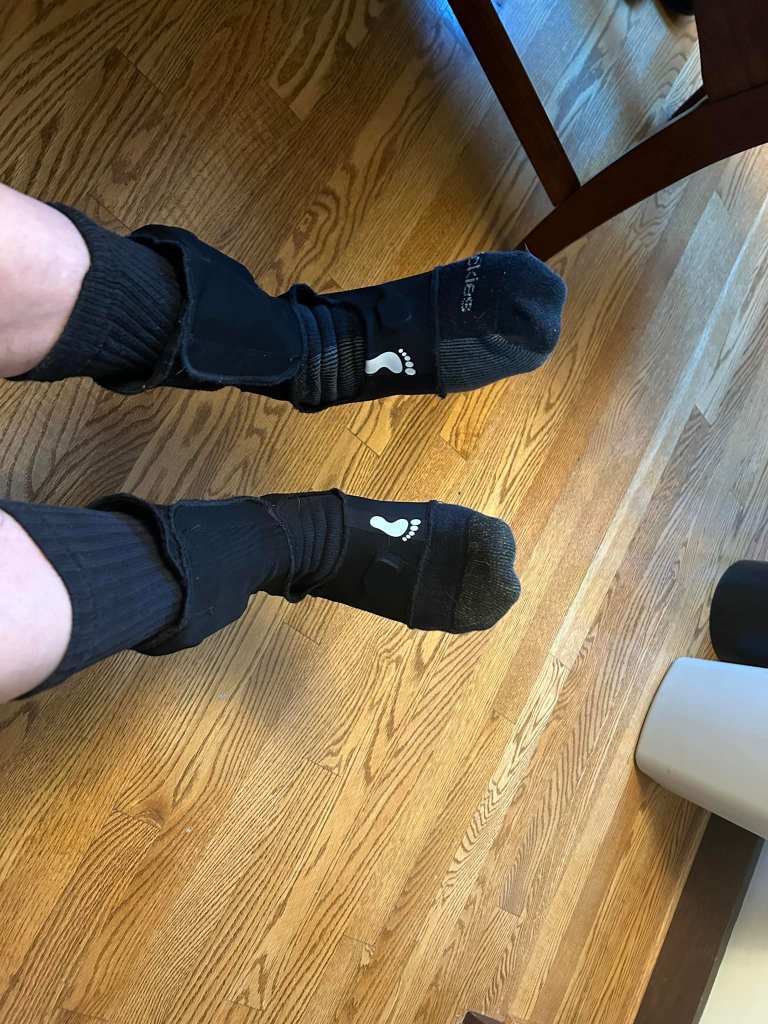
And I will be filling out paperwork every couple of weeks for year. OHSU is measuring the movements and activities of about 100 of us, trying to figure out the best ways to prevent falls.
Like the National Plan to End Parkinson’s Act, the study may or may not benefit Phil Bernstein. but I have benefited from thousands of Parkinson’s patients who have participated in earlier studies, and I’m happy to pay it forward.







 Shakin' Street -- A Parkinson's Blog
Leave a reply to kimberlyfeaeaf8899 Cancel reply