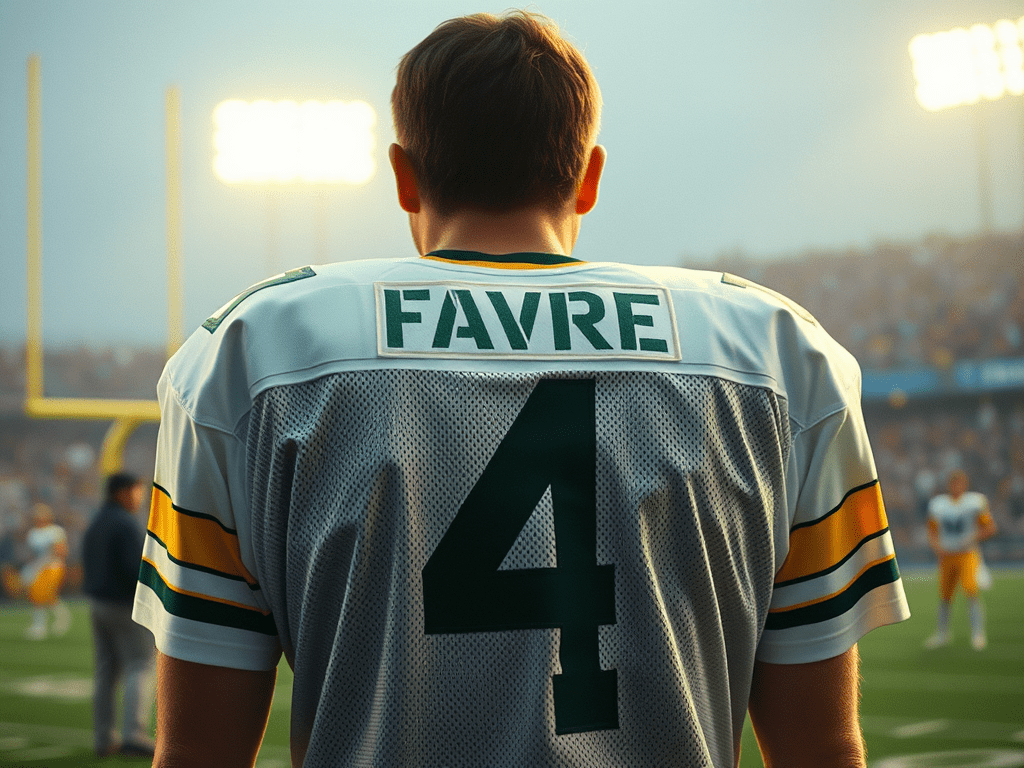
This week, Hall of Fame Quarterback Brett Favre announced that he’s been diagnosed with Parkinson’s Disease. His disclosure came as he testified before Congress on an unrelated matter, and did not have much detail.
This morning (Wednesday as I write this), TMZ filled in some of the blanks. Favre told TMZ that his first sign of trouble appeared in his right arm this past January:
He said he’d push it down, forget about it … but seconds later “it would be right back there.”
He also revealed despite having no issues with strength — when he’d go to use a screwdriver, he couldn’t simply hold it steady with one hand.
But he said what ultimately led him to go to the doctor was his struggles to get his throwing arm through a jacket hole.
“I felt my arm,” he said, “the strength was there, but I could not guide it. And it was the most frustrating thing.”
This resonates with me. In November, 2022, I tried to put my right hand into a glove and couldn’t convince my fingers to go into the holes. Not long afterwards, my doctor referred me to a neurologist.
Favre speculated that head trauma is a likely cause. He has said he had three or four confirmed concussions during his football career, and suspects there were many others that were not diagnosed.
A potential relationship between football and Parkinson’s is under investigation. NBC News reported that “A history of playing football was associated with a higher risk of a self-reported diagnosis of Parkinson’s or parkinsonism, according to a study published last year in the journal JAMA Network Open.
The study, based on surveys of people who’d played a range of organized sports, found that former football players who had longer playing history and higher level of competition were more likely to have a form of the condition.”
Favre, of course, played at the highest level for 20 years.
Setting the sport he played aside, a 2020 study published in Family Medicine and Community Health found that a single concussion in a person’s lifetime increased the likelihood of that person being diagnosed with Parkinson’s by 57%.
I’ve had two “official” concussions confirmed by a doctor: one when I fell off my bicycle at seven years old, and a second when I was knocked unconsious during a high school wrestling match at 18.
In addition to those, I can also remember having my “bell rung” during wrestling practice a few times.
On several occasions, my head collided with the mat (or an opponent’s knee) during practice, and I saw stars. I would leave the floor and sit on a bench with my head between my knees until the stars went away. Then our coach would send me back onto the mat.
In retrospect, this may not have been the smartest approach to a head injury.
Does Favre’s diagnosis — or mine — conclusively demonstrate a causal link between contact sports and Parkinson’s?
No. They are just data points. But each data point brings us closer to finding a cause for, and a way to prevent, the disease.
.
UPDATE: HOW’S PHIL’S DIET LOOKING?
A few weeks ago I wrote about studies linking Parkinson’s progression with diet. I also mentioned my efforts to eat foods that benefit me and avoid the bad stuff.
Last week I went to Nashville for a music festival called AmericanaFest. While the festival itself was fabulous, it is fair to say I did not eat properly — especially when my wife and I walked by a White Castle.
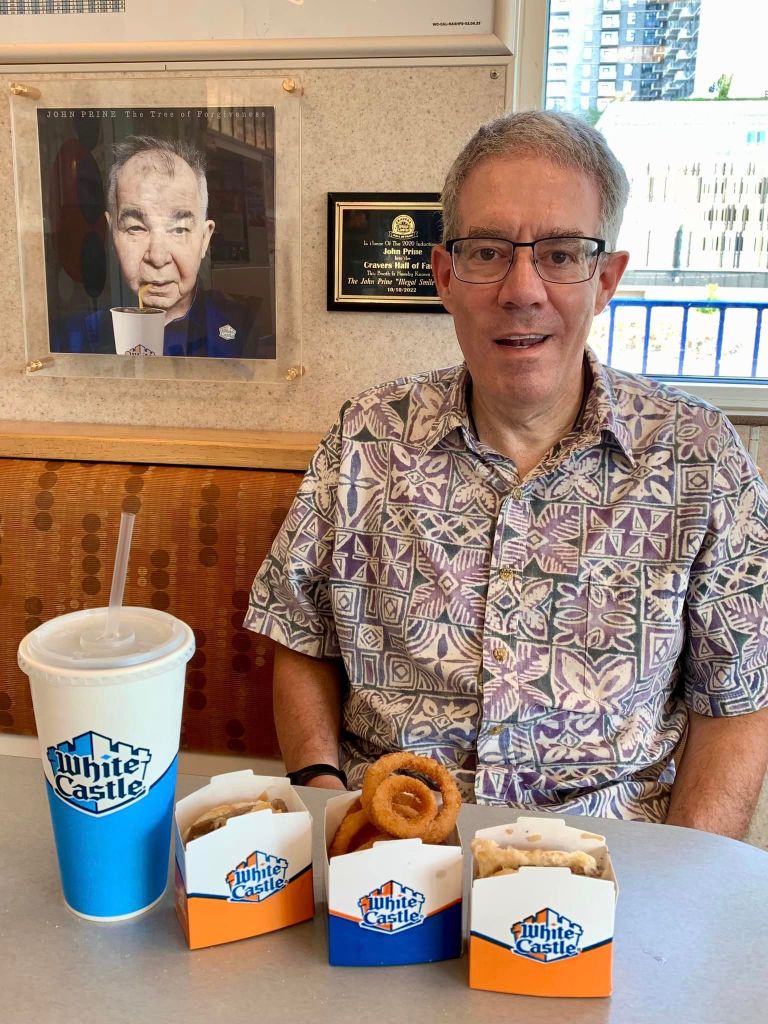
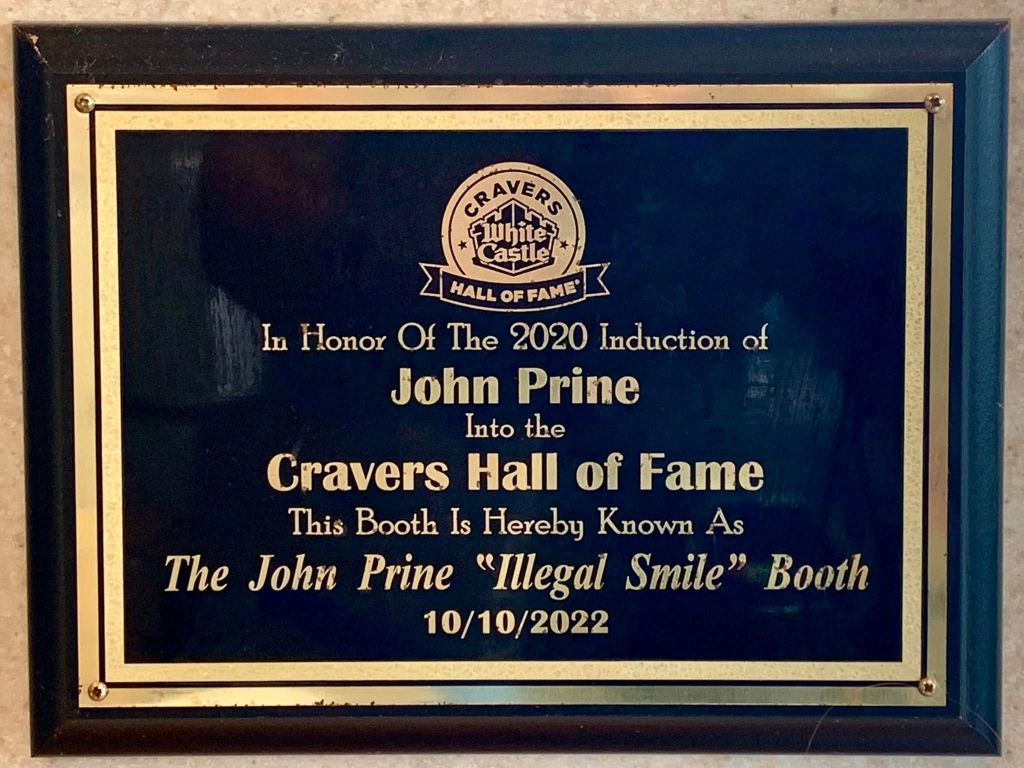
On the positive side, I stumbled on a special booth dedicated to singer-songwriter John Prine. White Castle inducted Prine into its “Cravers Hall of Fame” in 2020.
.
I intend to be better about my diet, effective immediately.
.
.
Bonus for Those Who Read to the Bottom
.
There are a lot of covers of John Prine’s “Angel from Montgomery.” Many of them are too reverent for my taste. This one, by Erin Harpe & the Delta Swingers, is adventurous and fun while still respecting the original.
.
Last week I posted Melanie’s cover of “Purple Haze.” YouTube decided I might also enjoy Jose Feliciano’s version. I wasn’t all that impressed until the 1:34 mark, when Feliciano unleashes a paint-peeler of a guitar solo. It’s worth the wait.





 Shakin' Street -- A Parkinson's Blog
Leave a reply to mmmeow60 Cancel reply