After my recent post on forcing myself to get out of bed for a 6am spin class, I heard from several readers who fully recognize they’d benefit from exercise…but aren’t doing it.
Each of them was up against the barrier that wouldn’t let them get started:
- For some, the barrier was physical – advanced Parkinson’s symptoms were keeping them from performing the exercises they wanted to perform.
- For some, it was financial – they didn’t have the money to join a gym or pay for class.
- Sometimes the issue was motivation – they just couldn’t bring themselves to do it.
As someone who, over the years, has started and stopped multiple exercise programs, I’m sympathetic – each of the above has given me a reason to stop something over the years.
But with Parkinson’s, exercise is so crucial I’ve stuck with it – the progression of the disease scares the hell out of me, and fear is a powerful motivational tool.
These barriers are real and legitimate. But in many cases you may be able to get past them. Here are some tools that might help you go around, over, or through the roadblocks.
Some disclaimers before I get started:
- Not everything I talk about is available in every market.
- In some cases, physical limitations may be so severe that meaningful exercise is impossible.
- Anxiety, depression or apathy – common symptoms of Parkinson’s – may make it especially difficult to get motivated. Please consult a medical professional about this.
Physical
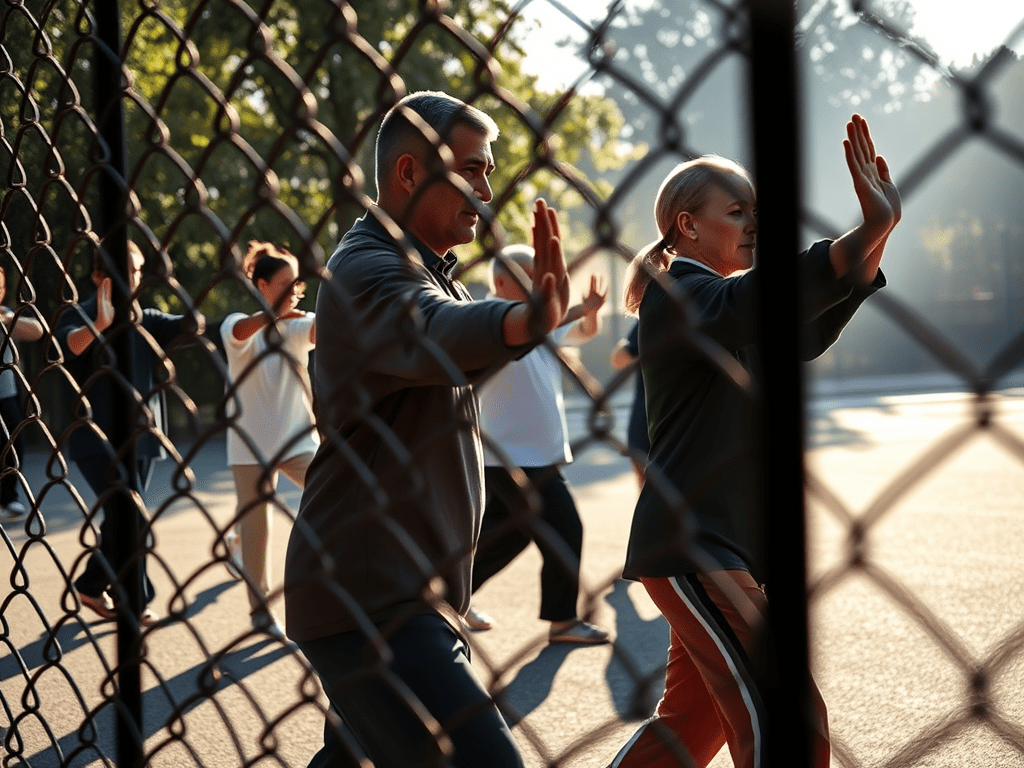
On a recent Tuesday, the instructor of my tai chi class set up chairs throughout the gym, and had all of the students run through the exercises in a seated position.
A couple of the students in our class have always participated while sitting down because of mobility issues, and this week’s experiment gave me an education on how folks with disabilities adapt to some of their challenges.
Seated tai chi is just one example of an exercise program adapted to folks with disabilities. Other examples:
- Chair Yoga classes are available in many markets.
- Some Rock Steady Boxing classes are designed for people who have balance issues or use walkers or wheelchair. My mom, who uses a wheelchair, attends an RSB class in St. Louis.
- This New York Times article describes a chair workout for people with mobility concerns.
- A YouTube search for “Workouts for Parkinson’s” brought up this collection of videos.
Financial
Times are tight, and gym memberships ain’t cheap. This can be especially fraught for those who had to retire early because of Parkinson’s, are dealing with unexpected medical expenses, or are just having trouble making ends meet.
Fortunately, there are sometimes resources available that can pay for all or part of the cost.
Here are some examples in my hometown of Portland, Oregon. Every market is different, and your mileage may vary, but you might be able to find something similar where you live:
- City programs: You may already be paying for these programs with your tax dollars — might as well make use of them. In my hometown there are several community centers, run by the City of Portland Parks & Recreation Department, with extensive exercise programs. Residents can participate in the Access Discount Program, which offers membership discounts of up to 90%.
- Financial assistance: A small nonprofit called the PD Rebel Project offers scholarships to pay part of the cost of a membership at our local Rock Steady Boxing gym. (Full disclosure: I am on the board of PD Rebel Project.)
- Medical insurance tie-ins: Some Medicare Advantage and Supplement plans, along with some employer-paid group insurance plans, include free gym memberships. United Healthcare, which runs my supplement plan, has a program called Renew Active, which allows me to attend classes at two different gyms for free. Other programs include Silver & Fit and Silver Sneakers. Check with your insurance provider – you may already be paying for this.
- Free classes: Parkinson’s Resources of Oregon offers a variety of virtual and in-person exercise classes, either free or at low cost.
A phone call might uncover some hidden treasure in your community. Call your city Parks & Rec office and ask about discounted exercise programs. If there’s a nearby gym, ask them if they offer any discounts or are associated with a nonprofit fund that can help. If you don’t ask, you don’t get.
And, of course, if you have Internet access, YouTube videos are free.
Motivation
As I mentioned earlier, Parkinson’s-related anxiety, depression, or apathy are separate category I’m not qualified to address. Talk with your doctor.
But if you are just dealing with a run-of-the-mill motivation issue, there are steps you can take to get off the couch and into the gym. Here are some tools that have worked for me and others:
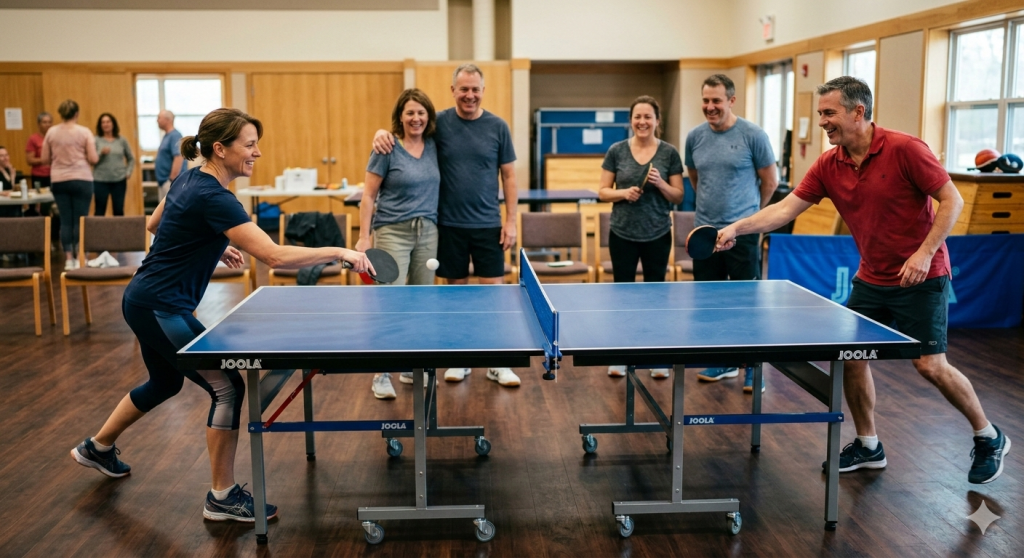
Scheduled classes: I cannot consistently work out at home or at the gym by myself — I just won’t do it. But if I have a group class scheduled at a specific time, I go. As of May, 2025 I attend scheduled sessions for indoor cycling, tai chi, Rock Steady Boxing, and ping-pong.
Make it simple to go: for my 6am spin class, I sleep in my workout clothes so I don’t have to look for them in the morning. I set my bike shoes next to my front door. My wallet and phone go in a fanny pack that sits on my breakfast table. All I need to do is get out of bed, eat, and head for the car.
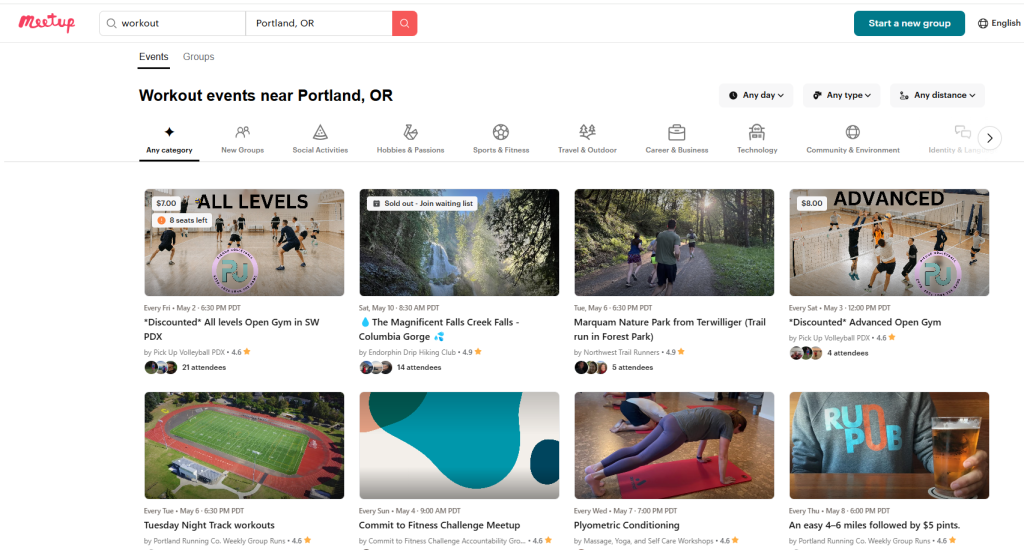
Accountability partners: If someone’s waiting for you at the gym or on the road, there’s a better chance you’ll show up. That could be a friend or co-worker, or someone you met in a class. If you don’t know anyone who’ll join you, Meetup.com may point you to a gathering of like-minded people.
- The 10-minute rule: tell yourself you’re going to the gym, or for a run or bike ride, for 10 minutes. Set a timer on your watch, and stop when the timer goes off. From there it’s up to you — you can go home and back to bed if you wish. But you may decide to keep going.
Best-selling author James Clear says a reader used this approach to lose 100 pounds. “‘In the beginning, he went to the gym each day, but he told himself he wasn’t allowed to stay for more than five minutes. He would go to the gym, exercise for five minutes, and leave as soon as his time was up. After a few weeks, he looked around and thought, “Well, I’m always coming here anyway. I might as well start staying a little longer.” A few years later, the weight was gone….We rarely think about change this way because everyone is consumed by the end goal. But one push-up is better than not exercising.”
Finally, an acknowledgement: none of this is easy, and none of this will work every time. Parkinson’s Substacker Emma Stubbs, in her “Who Stole My Dopamine” blog, takes issue with some of the chirpy motivational stuff:
When I get bombarded with exercise initiatives, challenges, and that constant tone of, If you just try a bit harder you’ll be fine!, I don’t feel inspired. I feel like I’m being told off. Like I’m not doing Parkinson’s properly. Like the only reason I’m struggling is because I haven’t “helped myself.”
And I can’t lie—some of these campaigns? They’re either aggressively chirpy (just SMILE through the tremors, Sandra) or so bleak I feel like I need a nap and a biscuit afterwards. Where’s the middle ground? Where’s the honesty? The nuance? The acknowledgement that Parkinson’s is weird and annoying and sometimes trying to exercise with it feels like wrestling a greased octopus in a hoodie?…
…So yes. Encourage us. Share the science. Be kind, be warm, be realistic.
But for the love of cockwombles, stop pretending we’re all just one vision board away from being motivational speakers in Lycra.
Do what you can, when you can, and let yourself off the hook when you can’t.
.
Bonus for Those Who Read to the Bottom
In honor of Warren Zevon, a national treasure who is finally in the Rock & Roll Hall of Fame.
The Grateful Dead had an adventurous take on Zevon’s biggest hit:
.
Willy DeVille sings the dickens out of “Carmelita.” Great performer, great song.
.
The Hindu Love Gods — basically, members of REM plus Zevon, pummel a Prince classic.







 Shakin' Street -- A Parkinson's Blog
Leave a reply to mentalitycheerfullya4b3f4e660 Cancel reply