
Even though I’ve been retired for a while, I still get occasional Direct Message recruiting pitches on LinkedIn. Some of them are legitimate opportunities. Some are scams. Usually I can tell the difference.
Last week I got fooled. No harm done — I figured it out before giving up any information. But the initial approach was good enough to start a dialog:

What caught me?
- The writer (or an AI bot) took the time to actually review my LinkedIn profile before writing. A lot of them just spray and pray, and the pitch is generic.
- She saw that I’m a Peer to Peer Mentor with Parkinson’s Resources of Oregon – something I really love doing.
While I am not looking to go back to work, the idea of mentoring for somebody with Pfizer was intriguing. Perhaps I could help a Viagra salesman firm up his book of business.
I was interested enough to write back.
.

.
Her reply missed the mark.

.
A grammatical error in the first sentence — jarring after the flawless approach. No mention at all of mentoring. And while she had initially invited me to chat with her, now she just wanted my phone number so her “boss” could contact me.
Was the reply written by a completely different person? Was the first message done by AI, with a human – one who had an uncertain relationship with written English — responsible for the follow up?
I was ready to bail out, but I’m a sales trainer at heart. I’d written a sloppy email or two in my day.
I decided to give her one more chance to get the discussion back on track. It did not go well – even LinkedIn’s automated system began to look askance.
.

.
I tried to suggest that she look elsewhere, but she didn’t take the hint:
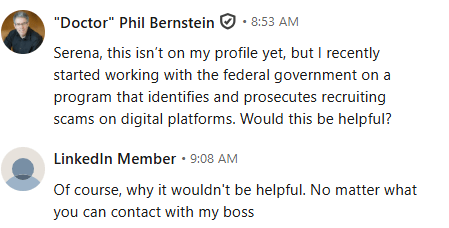
Game over. I blocked “Serena” and reported the exchange as a scam to LinkedIn.
What Jobseekers and People with Parkinson’s Have in Common
Scammers see us as prime opportunities:
- We’re dealing with forces outside of our control.
- Our situations have built-in urgency: we both struggle with financial and emotional stress, while PWP’s and their care partners must also cope with changing symptoms and disease progression.
- We’re searching for hope, and a better outcome.
- We’re online often, searching for answers and communicating with people we don’t know. This puts our data, and even our identities, at risk.
- We’re more likely to rely on others who claim to have inside information — recruiters and resume experts for jobseekers, medical gurus and supplement salespeople for those with Parkinson’s.
- Both groups may be willing to give our money, our private data, or both to someone who promises to solve their problems.
- Bonus for us on the “Parkinson’s” side: cognitive challenges can make us more likely to buy into a dubious proposition.
The buzzards are circling: useless or harmful supplements, strange devices, and magic patches sold by people with little or no medical training. As the federal government slashes regulations and its workforce, we can’t depend on the authorities to defend us from the miscreants.
We’re on our own to educate ourselves and steer clear.
Here’s one way to start:
In July, Parkinson’s Canada gave a webinar called “Dr. Google, and How to Spot Parkinson’s Misinformation.” You can watch it below.
Dr. Benzi Kluger, a professor of neurology and medicine at University of Rochester, starts by defining medical BS:
When someone claiming to care about your health sells you a product to help their wealth, without truly respecting you or your wellbeing.
Dr. Kluger warns against investing in unproven products when
- The seller claims the product is good for everything
- Proof of effectiveness relies on anectdotes
- The product is unregulated or untested
- The description of the product is made to sound science-y
This resonated with me.
I’ve been pitched on a product that, the company claims on its website, is only intended to support general health and wellness.
Its salespeople have an extensive library of testimonials from purported patients who say the product has cured — or at least reversed the symptoms of — a wide variety of maladies. From cancer to diabetes to Parkinson’s to general aging, there’s a video of someone who says this thing has delivered miraculous results.
There are no formal clinical trials demonstrating the product’s effectiveness in treating any of these ailments. But the testimonials are powerful.
So…does it actually work?
There’s no proof it does, and no proof it doesn’t. They’ve never tested it in any systematic way. So it depends on how much stock you put in the testimonials.
Dr. Kluger is clear on his position:
Testimonials and anectdotes should be treated for what they are — medical gossip…
…Without a control group, you don’t know if you’re simply taking a placebo.
And Parkinson’s patients, says the Michael J. Fox Foundation, are particularly receptive to the placebo effect.
The product isn’t likely to be harmful, but it’s spendy and not covered by insurance. I’m not convinced by the testimonials, and the lack of any real testing doesn’t give me much confidence. It’s sold on an MLM model, which always raises my guard.
So I’m not buying.
Should you?
I recognize as I write this that conventional science has not yet given us a medication to cure or even slow down Parkinson’s progression. So we have to at least look outside the box for treatments that might get the job done.
When presented with an outside-the-box option, we must balance the potential benefit against the expense and potential harm of the remedy.
View all claims with skepticism, and bring in a trusted loved one if you’re concerned about your judgment or cognition.
Don’t be afraid to take your time in making a decision. The opportunity will still be there tomorrow or next week.
In the words of Sergeant Phil Esterhaus, be careful out there.
.
Bonus for Those Who Read to the Bottom
AC/DC Edition
An impossibly young Angus, and Bon Scott in drag. What more could you ask for?
.
If the band had hired Janis Joplin, and couldn’t afford a set of bagpipes, “A Long Way to the Top” might’ve sounded like this:
I have no idea what a Guzheng is, or how it works. But I know what I like.









 Shakin' Street -- A Parkinson's Blog
Leave a reply to shakinstreet.com Cancel reply