
Can Our Driving Choices Be
Signs of Cognitive Decline?
Figuring out when it’s time to give up the keys can be challenging. Often it involves awkward conversations among family members, with a decision forced by a series of near misses or collisions.
Turns out there may be another, more objective way to uncover cognitive warning signs — the choices we make on when and where to drive. A recent study released by Washington University in St. Louis details the approach.
Researchers studied 56 subjects with mild cognitive impairment and 242 cognitively-healthy people. The study lasted three years.
According to Brain & Life Magazine,
At first, both groups had similar driving habits, but over time, people with mild cognitive impairment:
- Drove less often
- Avoided night driving
- Stuck to familiar routes
While the driving patterns of the two groups were similar at the start of the study, over time older adults with mild cognitive impairment had greater reductions in how many times they drove each month, how often they drove at night and how much they varied their routine in where they drove.
The researchers used driving factors such as medium and maximum trip distance, how often people went above the speed limit and how much they varied their routine to predict whether a person had developed mild cognitive impairment with 82% accuracy. Once they added in the factors of age and other demographics, cognitive test scores and whether people had a gene associated with Alzheimer’s, the accuracy improved to 87%. In comparison, using all of those factors without any driving information resulted in 76% accuracy.
To evaluate my driving, I’ve been using the AARP SafeTrip smartphone app for about a year. The app tracks speed, acceleration, braking and cornering, offering a score measured from 0 to 100.
As of today, SafeTrip thinks I’m a pretty good driver.
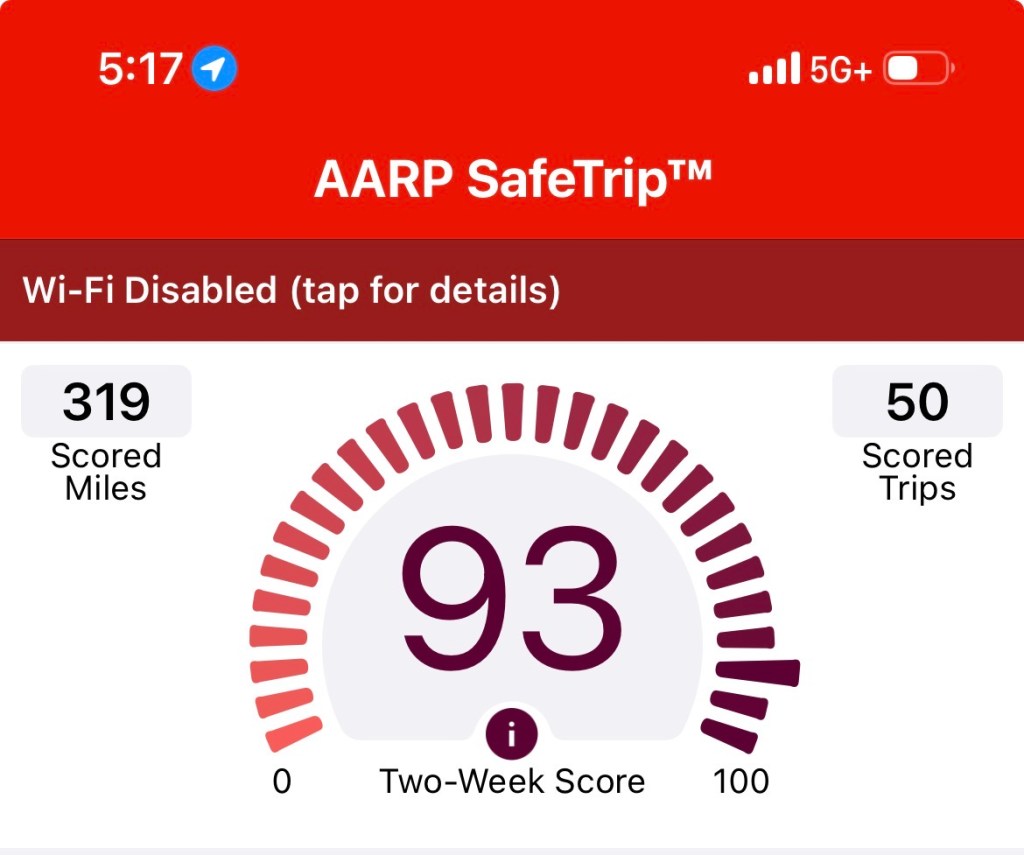
According to the app, my actions behind the wheel on a day-do-day basis indicate I’m doing the right things. But the app doesn’t track my routines or decisions — am I driving less than I did, or only driving during the daytime, or sticking to familiar routes?
Watching for those signs may help us take corrective steps early and avoid a tragedy down the road.
.
From the I Am Not Making This Up Desk:
Flatulence May Prevent Alzheimer’s
Before you roll your eyes, be advised this is actual science from the actual scientists at Johns Hopkins Medicine.
The short version:
The gas that causes the smell you always complain about is hydrogen sulfide. According to The Independent UK,
Johns Hopkins Medicine scientists looked at mice that were genetically modified to mimic human Alzheimer’s disease.
The mice were injected with a hydrogen sulfide-carrying compound called NaGYY, which slowly released passenger hydrogen sulfide molecules throughout the body. The mice were tested for changes in memory and motor function over a 12-week period.
Behavior tests on the mice showed that hydrogen sulfide improved cognitive and motor function by 50 percent compared to mice that did not receive the injections.
The mice that received the treatment were better able to remember the locations of platform edits and appeared more physically active than the mice that had simulated Alzheimer’s disease but did not receive the treatment.
Yes, it’s mice, with no proof yet that the benefit is the same for humans. But the possibility exists that my farts may prevent Alzheimer’s.
Some people who attended Wydown Junior High in Clayton, MO in the early 1970’s owe me an apology and some gratitude.
.
Update on Turkish Airlines and Parkinson’s
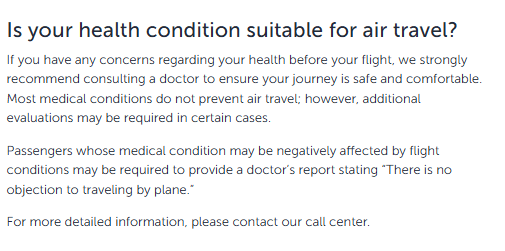
A few weeks ago I wrote about Mark Mardell, a PWP who was booted off a Turkish Airlines flight because he didn’t have a doctor’s note — airline policy at the time required those with Parkinson’s to bring a letter certifying they were capable of sitting on an airplane.
After an international backlash, including a cranky post on this blog, the airline has removed the policy from their English-language website.
Things are not yet perfect — the “Parkinson’s” policy may still appear on the airlines’s sites in other languages, and in English it’s been replaced by a more vague policy about “Health Conditions.”
But we’re heading in the right direction. Sometimes making noise works, and sometimes the good guys win.
.
Bonus for Those Who Read to the Bottom
Not long ago I posted Kent Nishimura’s acoustic guitar rendition of Michael Jackson’s “Thriller.” Irma has another take on the concept, with choreography.
.
Cold beer. That is all.
.
Brass Against mashes up the White Stripes’ “Seven Nation Army” and Curtis Mayfield’s “Pusherman.”
.
For those of you who keep asking why nobody’s ever done a hula hoop video to Ram Jam’s “Back Betty,” I hope you’re happy now.









 Shakin' Street -- A Parkinson's Blog
Leave a reply to shakinstreet.com Cancel reply