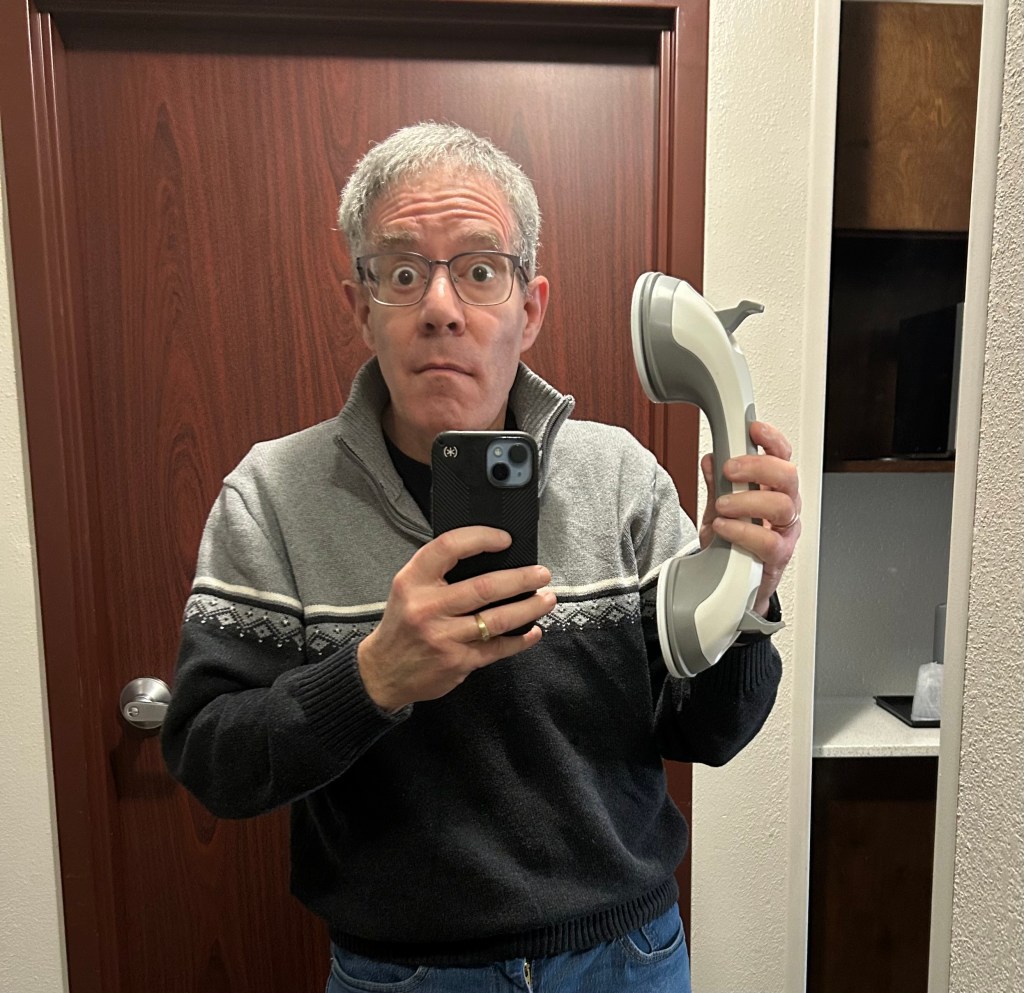
Do you travel with your own shower grab bar? I do.
This is yet another reason women adore me, and men wish they were me. But I digress.
Many hotels skip installing bars, but it never occurred to me to bring my own until I read a post by Wolfgang Wolf: “Insider Tips from a Disabled Traveler.”
Wolf wrote: “Consider taking grab bars. Not all hotels have them—or put them where you want them.”
He didn’t have to tell me twice. I found a 12‑inch vacuum grab bar on Amazon, tested it at home, and took it on a recent trip to St. Louis.
It attaches in 30 seconds. Removing it takes five minutes and a credit card wedged under the suction cups—a good sign. You want it to hold.
As the manufacturer will tell you, these bars are not designed to hold an adult’s full weight, but they are terrific to lean on while applying soap, or to steady yourself if you begin to lose your balance.
Earlier this week, my portable grab bar spent a couple of days as the only bar on the shower wall of Room 318 of the St. Louis Airport Holiday Inn Express.
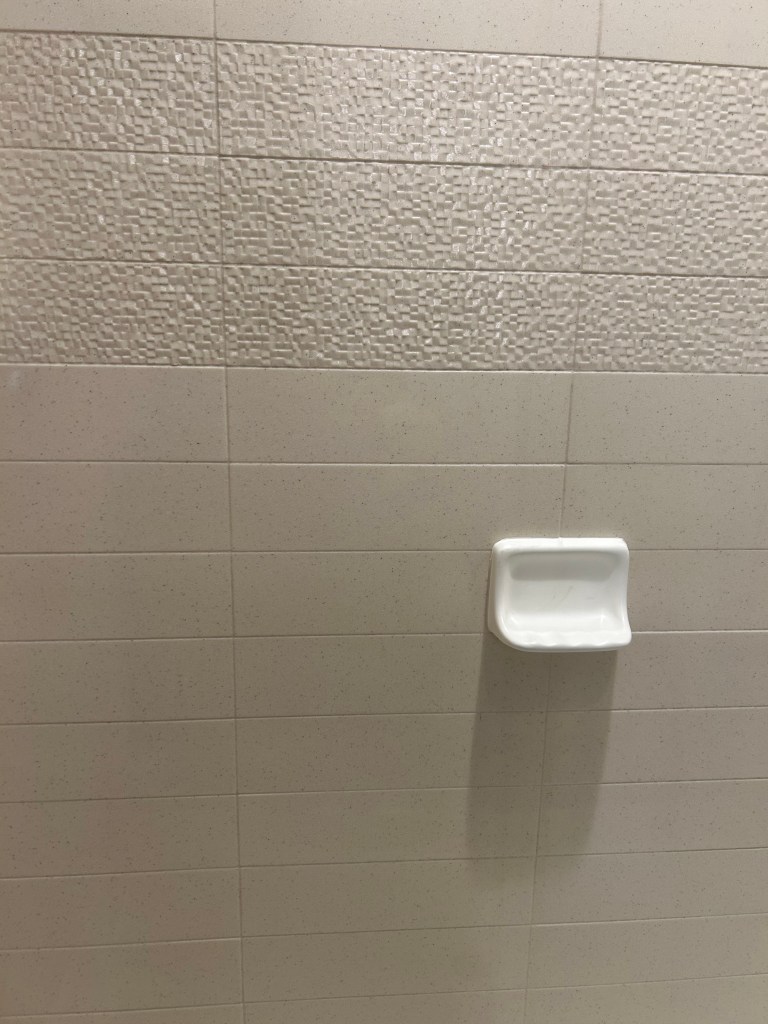
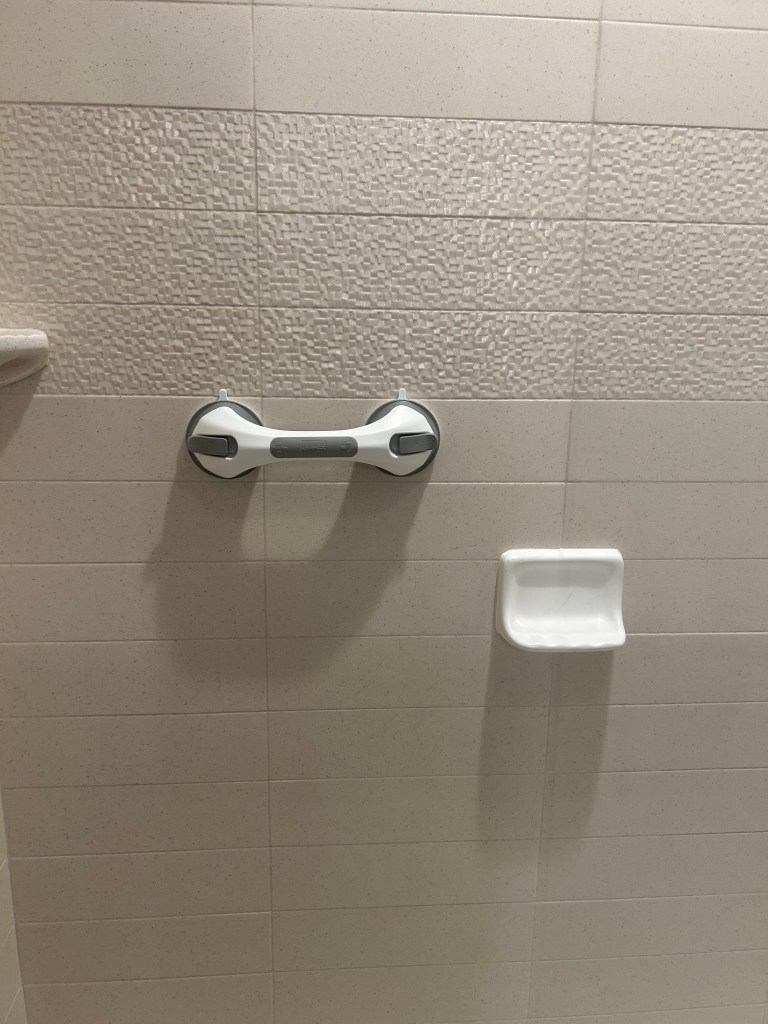
On getaway day, I got up a few minutes early to take it off when it was time to check out.
Recommended — would buy again.
More From the “I Did Not Know That” Desk
CATSA Facilitators, TSA Cares
A few months ago, hosts Bryce Perry and Brian Campkin devoted an episode of the Life In Motion Parkinson’s Podcast to the challenges of traveling with Parkinson’s.
Among the issues they discussed: how to address balance and mobility issues while going through airport security.
If you need some help, they recommended approaching an officer and quietly telling them you’ve got Parkinson’s. There are alternative screening method available, but you need to ask.
Perry and Campkin are Canadians. In Canada’s 16 busiest airports, the Canadian Air Transport Security Authority (CATSA) has specially trained “Facilitators” to help passengers through the security screening process.
Poking around on the interwebs after listening to the podcast, I learned that in the United States, the Transportation Security Administration (TSA) has a program devoted to helping those who need extra assistance, called TSA Cares.
For travelers with Parkinson’s, the TSA Cares website has information on rules regarding disabilities, medications, and medical equipment.
You can also request the services of a TSA Passenger Support Specialist:
A PSS is a TSA officer who has received specialized training, including how to effectively assist and communicate with individuals with disabilities or medical conditions; and passengers who need additional screening assistance. Requesting PSS service does not exempt you from security screening.
To make the request, please contact us at least 72-hours prior to your departure by completing the TSA Cares form or calling TSA Cares at (855) 787-2227.
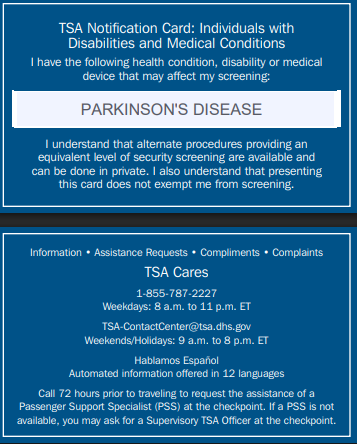
If you are already at the airport, you can request extra help at screening by handing a TSA officer a TSA Notification Card. According to Flying Angels:
The TSA Notification Card allows travelers with disabilities to discreetly inform airport security personnel about any medical conditions, disabilities, medical devices on their person or medications that might impact the screening process. It does not mean that travelers with disabilities who hold the card can skip the screening process, as this is still a requirement.
The Notification Card can be downloaded from TSA.gov, and looks like this (I filled in the white box):
You don’t need to have the card to request assistance — you can always follow Perry and Campkin’s advice to just say something to an officer. But the card can be especially useful for those who have difficulty communicating. And it never hurts to have an official TSA document to buttress your case.
Worth noting: if you buttress your case at the airport, you’ll have a flying buttress. Thank you. Thank you very much. I’m here all week.
Elsewhere in the airport, you can discreetly request help by wearing a Sunflower Lanyard:
The Hidden Disabilities Sunflower is a simple tool for you to voluntarily share that you have a disability or condition that may not be immediately apparent – and that you may need a helping hand, understanding, or more time in shops, at work, on transport, or in public spaces.
TSA PreCheck Touchless ID — A Solution to a Problem I Didn’t Realize I Had
Each time I get in the TSA line, I take my ID out of my wallet and my phone (with boarding pass) out of my pocket.
After presenting them to the agent at the desk, I then have to put the ID back into the wallet and find a place in my bag to store the phone so it doesn’t set off an alarm.
This dance happens while the line slowly advances to the conveyor belt and metal detector.
Parkinson’s has done a number on my manual dexterity. Trying to multitask in line has caused me, more than once, to lose track of my stuff. Then comes the walk of shame from my gate back to security whatever I’ve lost.
I always considered the hassle an unavoidable part of air travel — until I tried TSA PreCheck Touchless ID a few days ago.
If you have PreCheck and a valid US passport, Touchless ID allows you to leave your ID and boarding pass in your pockets as you go through security. You stop briefly while the system snaps a photo and compares it to the passport photo — then you’re on your way.
What happens to the photo? Here’s what the TSA website says:
TSA officers now use biometric cameras to assist with identity verification. Images are not used for law enforcement, surveillance, nor shared with other entities. Your photo and personal data are deleted within 24-hours of your scheduled flight departure.
You’ll have to decide if you believe that, and how much it matters.
On a recent Sunday morning at Portland International Airport, there was no line at the Touchless ID station. I walked up, posed for a photo, waited for the agent to wave me through, and continued on my way.
Total time elapsed, less than a minute.
As someone with a balky right hand, my take is that not having to juggle documents in line is a meaningful benefit.
In return, I’m willing to accept the possibility that Kristi Noem has my photo in a file on her desk.

I Have Questions
Leave an answer in the Comment section below!
- What’s your favorite Parkinson’s travel hack?
. - Have you ever requested help from a Canadian Facilitator or a TSA Passenger Support Specialist? Were you happy with the result?
. - Have you tried TSA PreCheck Touchless ID? How’d it go?
Bonus for Those Who Read to the Bottom
Fab Four Edition
Joe Bonnamassa turns “Taxman” into a 7-minute electric blues shuffle.
.
My favorite Beatles cover was Wilson Pickett’s “Hey Jude” — until I heard this. Herbie Goins was an American soul singer who was known mostly in England and Italy during the 60’s.
.
A bluegrass “Hard Days Night?” A bluegrass “Hard Days Night!” Thank you to loyal blog reader Russ for bringing it to my attention several years ago.
.
The Reed Sisters had a public access cable TV show in Oak Ridge, Tennessee in the 1970’s and 80’s. Luckily, someone thought to preserve some of the performances — you can find several on YouTube — and there is a documentary in the works. The sisters don’t really know the words to “From Me to You,” but they’re doing their best.
.
This has nothing to do with the Beatles.






 Shakin' Street -- A Parkinson's Blog
Leave a reply to shakinstreet.com Cancel reply