
There are almost 6500 lawsuits filed in East St. Louis. Another 1600 in Pennslyvania, and nearly 500 in California.
Each of these 8600 cases represents a person who has Parkinson’s Disease, and who believes paraquat caused it.
Paraquat is a synthetic herbicide used for agrucultural weed–control, and to dry out plants before harvesting. In the United States, it is used on soy, cotton, corn, grapes, almonds, orchards and vegetables, legumes, sugar cane, potatoes, and sunflowers.
Paraquat is extremely effective, and relatively inexpensive to use. There’s also a lot of evidence it may cause Parkinson’s.
Long-term use has been linked, in a variety of studies including this one, to PD.
According to Ray Dorsey and Michael Okun’s The Parkinson’s Plan, paraquat manufacturers have known about this link for a long time:
The company’s researchers showed that large doses of paraquat produce the symptoms of Parkinson’s, including a stiff gait and tremors, in three different mammalian species: rats, mice, and rabbits. These studies were performed in the 1960s.
Later human studies spanning decades backed this up. The industry response? Deny, suppress, spin.
Which brings us to today, and roughly 8600 lawsuits. A company called Syngenta now produces the product.
According to the company website, Syngenta employs over 56,000 people in 90 countries.
Not all of those 56,000 people manufacture paraquat — the company makes other products, and also has people working in departments like accounting, marketing and IT.
Upton Sinclair once said “It is difficult to get a man to understand something when his salary depends upon his not understanding it.”
Sinclair wasn’t thinking of Syngenta when he said that, but it’s worth noting that the company addresses the issue this way:
However, no peer-reviewed research has ever concluded that paraquat causes Parkinson’s. The theory that paraquat causes Parkinson’s is not accepted by the medical or scientific community. In fact, a recent review of the scientific literature, published in the journal NeuroToxicology, found that “a consensus exists in the scientific community that the available evidence does not warrant a claim that paraquat causes Parkinson’s disease.”
But there’s a growing mountain of evidence linking paraquat and Parkinson’s. 74 countries — including Switzerland, where Syngenta is based, and China and the UK, where it’s manufactured — have banned paraquat’s use.
The evidence convinced them.
It has not yet convinced the US Environmental Protection Agency. Or, presumably, most of Syngenta’s 56,000 employees.
Which brings me to my question:
If you, as a Syngenta employee, do know all this — if you are aware of compelling and growing evidence that a product your company makes may cause Parkinson’s — what makes you continue to work there?
Full Disclosure: I Make My Own Compromises
- I subscribe to Spotify, which is credibly accused of causing economic harm to working musicians.
. - I buy a lot of stuff from Amazon, which has done an enormous amount of damage to local retailers.
. - And I worked for 20 years at a company that many blame for ruining the radio industry.
If you challenge me, I will come up with a some pretty good reasons why it’s ok for me to be involved with these companies. Perhaps my reasons are horsefeathers, but I can live with them.
We all have a place we draw the line. Mine starts, I guess, at progressive neurological diseases.
I couldn’t work in Syngenta’s accounting department. Could you?
.
.
Free Ping Pong for Parkinson’s in
Northeast Portland
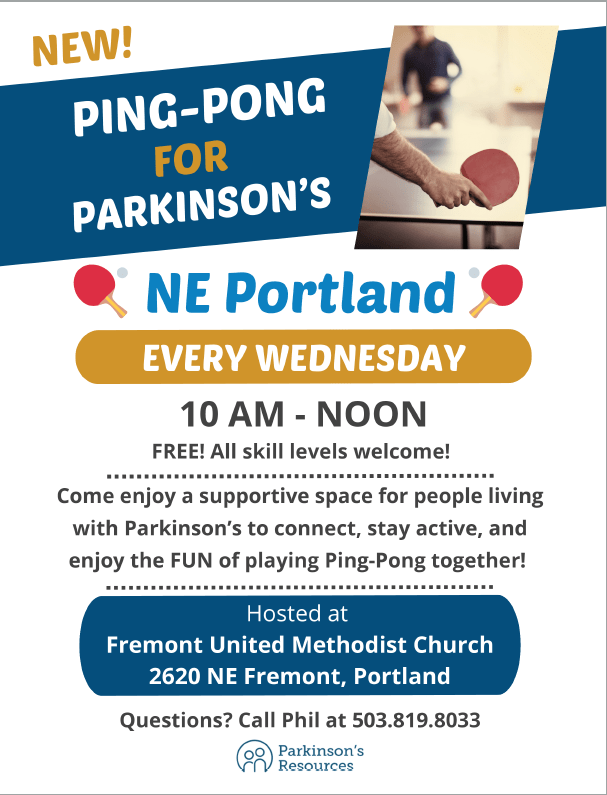
If you have Parkinson’s and live or work in Northeast Portland, there’s now a place to play ping pong for free — courtesy of Parkinson’s Resources of Oregon.
When: Every Wednesday from 10am to 12 noon
.
Where: Fremont United Methodist Church, 2620 NE Fremont in Portland
.
Price: Free!
.
Your host: Me!
.
For more info, email me at therealshakinstreet@gmail.com
.
Bonus for Those Who Read to the Bottom
.
Robert Plant and Imelda May with an R & B take on Led Zeppelin’s “Rock and Roll.”
.
From the I Had No Idea Department: I recently learned, from Andrew Hickey’s “A History of Rock Music in 500 Songs” podcast, that the first recorded version of Pete Townsend’s “Magic Bus” was by an obscure English band called The Pudding. Here it is:
.
In 2005, Petra Haden released an acapella cover of the entire The Who Sell Out album. Here’s one exceptional track:
.
In honor of the USA Men’s and Women’s Ice Hockey teams.






 Shakin' Street -- A Parkinson's Blog
Leave a reply to pdxknitterati Cancel reply