The Price of a Paycheck: The Paraquat-Parkinson’s Dilemma

There are almost 6500 lawsuits filed in East St. Louis. Another 1600 in Pennslyvania, and nearly 500 in California.

Each of these 8600 cases represents a person who has Parkinson’s Disease, and who believes paraquat caused it.

Paraquat is a synthetic herbicide used for agrucultural weed–control, and to dry out plants before harvesting. In the United States, it is used on soy, cotton, corn, grapes, almonds, orchards and vegetables, legumes, sugar cane, potatoes, and sunflowers. 

Paraquat is extremely effective, and relatively inexpensive to use. There’s also a lot of evidence it may cause Parkinson’s.

Long-term use has been linked, in a variety of studies including this one, to PD.

According to Ray Dorsey and Michael Okun’s The Parkinson’s Plan, paraquat manufacturers have known about this link for a long time:

The company’s researchers showed that large doses of paraquat produce the symptoms of Parkinson’s, including a stiff gait and tremors, in three different mammalian species: rats, mice, and rabbits. These studies were performed in the 1960s.

Later human studies spanning decades backed this up. The industry response? Deny, suppress, spin.

Which brings us to today, and roughly 8600 lawsuits. A company called Syngenta now produces the product.

According to the company website, Syngenta employs over 56,000 people in 90 countries.

Not all of those 56,000 people manufacture paraquat — the company makes other products, and also has people working in departments like accounting, marketing and IT.

Upton Sinclair once said “It is difficult to get a man to understand something when his salary depends upon his not understanding it.”

Sinclair wasn’t thinking of Syngenta when he said that, but it’s worth noting that the company addresses the issue this way:

However, no peer-reviewed research has ever concluded that paraquat causes Parkinson’s. The theory that paraquat causes Parkinson’s is not accepted by the medical or scientific community. In fact, a recent review of the scientific literature, published in the journal NeuroToxicology, found that “a consensus exists in the scientific community that the available evidence does not warrant a claim that paraquat causes Parkinson’s disease.”   

But there’s a growing mountain of evidence linking paraquat and Parkinson’s. 74 countries — including Switzerland, where Syngenta is based, and China and the UK, where it’s manufactured — have banned paraquat’s use.

The evidence convinced them.

It has not yet convinced the US Environmental Protection Agency. Or, presumably, most of Syngenta’s 56,000 employees.

Which brings me to my question:

If you, as a Syngenta employee, do know all this — if you are aware of compelling and growing evidence that a product your company makes may cause Parkinson’s — what makes you continue to work there?

Full Disclosure: I Make My Own Compromises

  • I subscribe to Spotify, which is credibly accused of causing economic harm to working musicians.
    .
  • I buy a lot of stuff from Amazon, which has done an enormous amount of damage to local retailers.
    .
  • And I worked for 20 years at a company that many blame for ruining the radio industry.

If you challenge me, I will come up with a some pretty good reasons why it’s ok for me to be involved with these companies. Perhaps my reasons are horsefeathers, but I can live with them.

We all have a place we draw the line. Mine starts, I guess, at progressive neurological diseases.

I couldn’t work in Syngenta’s accounting department. Could you?
.

.

Free Ping Pong for Parkinson’s in
Northeast Portland
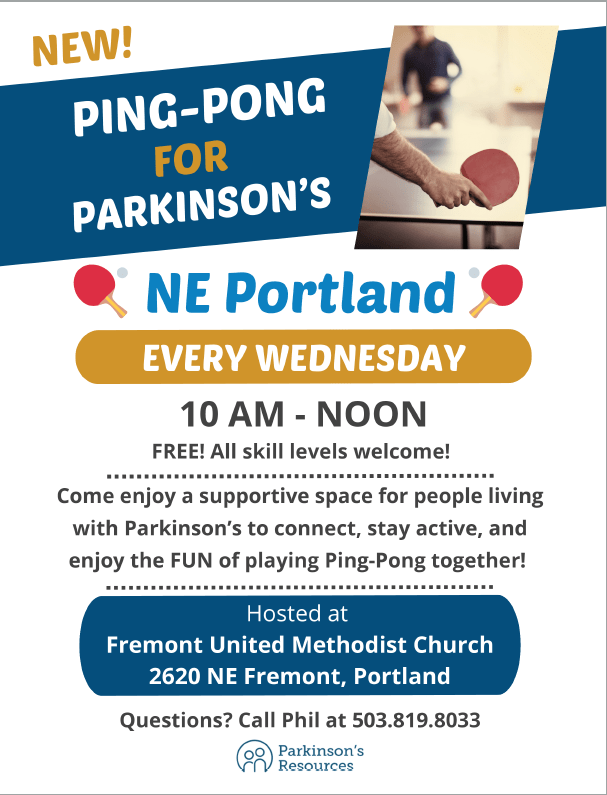
If you have Parkinson’s and live or work in Northeast Portland, there’s now a place to play ping pong for free — courtesy of Parkinson’s Resources of Oregon.

When: Every Wednesday from 10am to 12 noon
.
Where: Fremont United Methodist Church, 2620 NE Fremont in Portland
.
Price: Free!
.
Your host: Me!
.
For more info, email me at therealshakinstreet@gmail.com
.

Bonus for Those Who Read to the Bottom

.

Robert Plant and Imelda May with an R & B take on Led Zeppelin’s “Rock and Roll.”

.

From the I Had No Idea Department: I recently learned, from Andrew Hickey’s “A History of Rock Music in 500 Songs” podcast, that the first recorded version of Pete Townsend’s “Magic Bus” was by an obscure English band called The Pudding. Here it is:

.

In 2005, Petra Haden released an acapella cover of the entire The Who Sell Out album. Here’s one exceptional track:

.

In honor of the USA Men’s and Women’s Ice Hockey teams.

15 responses to “The Price of a Paycheck: The Paraquat-Parkinson’s Dilemma”

  1. Dave Avatar
    Dave

    Well, you can’t spell Syngenta without “syn”

    Like

  2. shakinstreet.com Avatar

    I’m trying to come up with a Gram Parsons joke where the punchline is “The Gilded Palace of Syngenta.”

    It’s not really working so far.

    Like

  3. KEVIN ROWAN Avatar

    I dunno, Phil. Why do most people work? How does this country choose leaders? When will Robert Plant stop being incredible? You raise many questions calling for hard answers. I suppose most of us are doing the best we can, and all of us could stand to do a little better. To address your question: no, I couldn’t work at a place that makes poison. But I’m sure I’ve used poisons against rodents and weeds. Compromises and trade-offs affect our choices every day. It’s a matter of degree perhaps. That, finding a way to get through the day.
    Thanks for prompting me to think a little harder about doing Good. You’re no saint, but you’re all right.

    Like

    1. shakinstreet.com Avatar

      Thanks for the insight, Kevin. I guess we’re all trying to get through the day. “No saint, but all right” might be the best most of us can hope for.

      Like

  4. Susan Rich Avatar

    Interesting think piece. If one has the economic luxury to choose, then it becomes easier to dance with the angels. I’d like to think I would choose jobs/purchases that don’t harm a soul, but even the clothes on my back are likely, sadly, a product of slave labor. When we know better, we do better, but even then…compromises exist.

    Liked by 1 person

    1. shakinstreet.com Avatar

      You are right, Susan. It’s impossible to live day-to-day without doing some damage, or doing business with someone who is. The iPhone I am thumb typing this on may have been assembled by a nine-year-old boy. But I’m not going to give it back.

      I guess we all have to figure out where our personal line is, and endeavor to stay on the right side of it.

      Like

  5. pdxknitterati Avatar

    I knit the sweater I’m wearing today. I believe the yarn dyer is an ethical dyer. Where did the yarn come from? It’s superwash,, which may not be environmentally friendly in the processing. And where/how were the sheep raised? I don’t know. But I look darn cute today.

    Like

    1. shakinstreet.com Avatar

      On the list of activities that might do harm, I’d rank your transgression well below manufacturing a product that causes a debilitating chronic disease. But I may be biased.

      Like

  6. jchrisanthony Avatar

    On the surface, I don’t think I could work for a company such as Syngenta. I like to think I’m a better person than that. If that were the only job available, maybe I would.

    This is an apple-to-orange comparison, so take it with a grain of salt. I served in the military and civil service for almost 40 years. I served under a couple of administrations from both parties whose policies did not align with my personal beliefs. I spent four months in the Middle East during the Clinton administration, which was viewed by many as a distraction from current events. I wonder how many military personnel who are now in the Middle East do not agree with the mission. I couldn’t quit, and they can’t. Again, apples-to-oranges.

    Your post is a thought-provoker, for sure.

    Like

    1. shakinstreet.com Avatar

      You are right, Chris — the military is a different animal. Except for the (recently controversial) exception for illegal orders, you’ve got to do what you’re told, and you can’t just give two weeks’ notice if you don’t like your job. I suspect that a big percentage of folks who make the military a career may find a time or two when their employer is doing something they object to.

      A few years ago I read a book by Eyal Press called “Dirty Jobs: Essential Jobs and the Hidden Toll of Inequality in America” — an examination of jobs that on some level we all know someone is doing, but would rather not think about. Workers on a slaughterhouse floor, correction officers, that sort of thing. The rest of us accept the benefits without ever experiencing what those workers go through.

      One of the early chapters covered military drone operators carrying out targeted killings. It was an eye-opener: they are in no physical danger but suffer greatly from the psychological toll of doing the work.

      Life, as Rodney Crowell once said, is messy.

      Like

  7. JB358PWP Avatar
    JB358PWP

    All of these comments hit the points. I especially like what Susan says, “When we know better, we do better, but even then..” As others said, finances play a major role, especially at the cost of living today. I’d like to think I would find a different job, but those are hard to come by, as people are desperately holding on to the jobs they have. I can say, if I was close to retirement (within 5 or so years), I would stay. I boycotted Target and Amazon briefly, but went right back. If nothing else, they employ thousands of people, and that’s a big factor. Do we need more unionizing? Yes, but so many can’t risk losing their even minimum wage jobs. I’m wrestling with how much I can say to my employer right now. I can’t afford to quit or be fired.

    Like

    1. shakinstreet.com Avatar

      You’re absolutely right — it’s a whole lot easier to quit your job on principle when there’s another job waiting for you. It wasn’t that long ago that we had the “Great Resignation,” and it felt like EVERYBODY was jumping ship. The pendulum has swung in the other direction, and it’s swung hard.

      Liked by 1 person

      1. JB358PWP Avatar
        JB358PWP

        Thank you for the thought provoking question, though. It’s good to be reminded, because we all get a little lax sometimes. I try to buy small business, environmentally friendly, clean ingredients, and American or European made on Amazon, but sometimes I have to compromise due to cost. There just doesn’t seem to be any clear cut options anymore.

        Like

  8. Sharon Bergman Avatar
    Sharon Bergman

    The ping pong on ice video is pretty cool! Looking forward to playing ping pong with you and others at the new NE Portland location and thanks so much for getting it organized. I’ve lost some ground the past couple of weeks since I’ve been sick (and not exercising) and I notice I’m moving slower. Playing ping pong the past year seems to help me to move a little faster and mostly it’s just so much fun!

    Like

    1. shakinstreet.com Avatar

      Looking forward to seeing you at Day 1 of Ping Pong in NE Portland!

      Like

Leave a reply to jchrisanthony Cancel reply

I’m Phil Bernstein

I was diagnosed with Parkinson’s Disease on May 25, 2023. At the time, I was only vaguely aware of Parkinson’s — primarily from articles in People about Michael J. Fox. And I didn’t know anyone with the disease.

Now, I know a lot more about the illness, and I’ve joined the Parkinson’s community in my hometown of Portland, Oregon.

I’ve found that writing helps me think through challenges, and this illness definitely qualifies as a challenge. I’ve started Shakin’ Street to help me think through the various obstacles, tools, and resources that a newly-diagnosed Parkinson’s patient encounters along the way.

I hope some of these posts help you address and tackle your own challenges.

Let’s connect