
If present-day you could talk to yourself on the day you were diagnosed with Parkinson’s, what would you say?
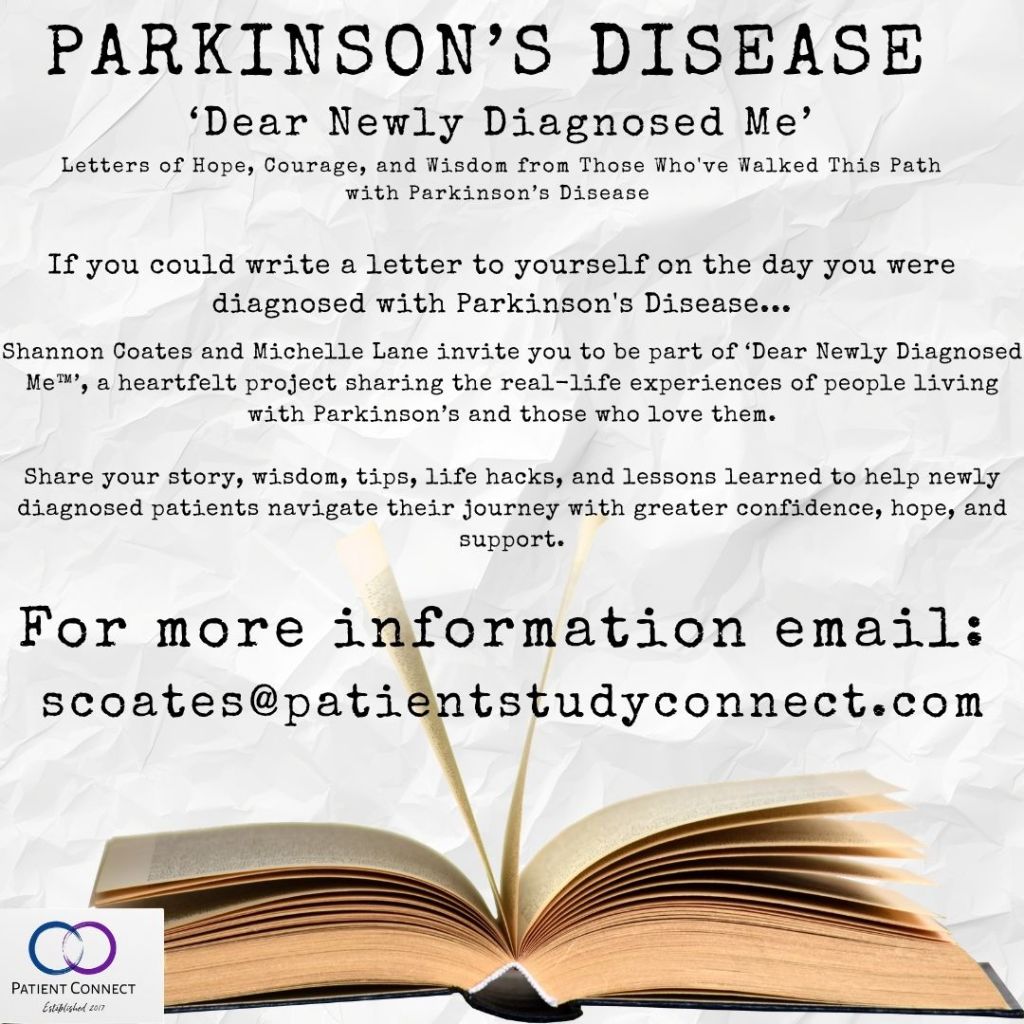
A pair of Parkinson’s patient advocates named Shannon Coates and Michelle Lane are working on a book called Dear Newly Diagnosed Me. They’re asking people with Parkinson’s to write letters to themselves and send those letters for possible inclusion in the book.
I can’t tell you whether to submit such a letter for publication — you may want the world to know your thoughts, or you may want to keep them private. Either way, the exercise of writing might benefit you, even if nobody else ever sees what you write.
A Parkinson’s diagnosis is not just a medical event. There are emotional, professional, and identity ramifications as well. Questions may pop into your mind as you walk out of your neurologist’s office:
- How long can I keep working?
- Do I need to tell my boss? What about my coworkers?
- How does this affect my marriage? My friendships? My relationship with my kids?
- How bad are things going to get? How can I prepare for that?
- What can I do about this?
I’d already been through several of the Kubler Ross stages of grief by the time I got the official word — it confirmed what I had suspected for a while. Acceptance came pretty quickly for me.
But there was still lots I didn’t know on Diagnosis Day — all of the above questions (plus “Where can I find a new doctor?”) were in my head as got back in the car after the appointment.
A study published in the journal Anxiety Stress Coping concluded that writing about emotional events (known as expressive writing) can have “a positive effect of expressive disclosure specifically on anxiety.” Researchers point to reduced stress and better emotional processing.
Cambridge researchers Karen A. Baikie and Kay Wilhelm, in a review of multiple studies, found that …
…expressive writing results in significant improvements in longer-term physical health outcomes such as illness-related visits to the doctor, blood pressure, lung function, liver function, and number of days in hospital. Expressive writing has also produced significant benefits in a number of measures of immune system functioning.
.
Since the day of my diagnosis, I’ve seen a thing or two, which has caused me to learn a thing or two. Some of that has appeared in this blog, but I may have held a thing or two back. Perhaps you have, too.
This might be a good time for both of us to write a letter to our slightly-younger selves. For inspiration, you can find examples of these letters here, here, and here.
If you’re interested in submitting your letter for inclusion in Dear Newly Diagnosed Me, you can ask Shannon Coates for details on how the process works. Her email is scoates@patientstudyconnect.com.
You can also keep your story to yourself if you prefer — the benefit from expressive writing comes from the act of writing itself. Submit your story, or delete it, or print it and stick it in a drawer — you’ll win either way.
.
.
Bonus for Those Who Read to the Bottom
Want to support this blog?

Don Rich was Buck Owens’ longtime guitarist and fiddler. Here’s Rich with the Buckaroos, in front of a motionless Norwegian audience, doing a very good cover of The Band’s “Up on Cripple Creek.”
.
Technotronics’ “Pump Up the Jam,” performed by a one-man-band in front of a canine audience of one.
.
There are dozens of “Thunderstruck” covers on YouTube. This is my favorite.
.
The best toy-keyboard-ukulele-kazoo cover of a David Bowie song you’ll see today.
.
Two ukes tackle “Under Pressure,” and magic ensues.





 Shakin' Street -- A Parkinson's Blog
Leave a comment